Spectra Assure Free Trial
Get your 14-day free trial of Spectra Assure for Software Supply Chain Security
Get Free TrialMore about Spectra Assure Free TrialOn November 10, 2026, ESET researchers disclosed Cereal, a modular espionage toolset used by the Russia-aligned Turla group against Microsoft Exchange servers at two government organizations. In Kazakhstan, ESET detected the tooling on November 28, 2025. At a government organization in Romania, ESET found a compromise dating to December 23, 2025, including a selective collection of emails involving NATO and European Union institutions. The attackers could take copies of selected messages while normal delivery continued. ESET attributed the activity to Turla with high confidence.
What made the operation difficult to spot was not only what the malware did, but where it lived. Instead of relying on a conspicuous outside command server, a component called CerealNeuron listened for specially crafted web requests on the compromised Exchange server. Another component, CerealBox, worked inside Exchange’s existing mail-transport process rather than registering an obvious new transport agent. ESET’s analysis describes a stealthy, long-term collection operation built around trusted infrastructure.
ReversingLabs (RL) examined the file evidence behind that account. Starting with the indicators ESET published, our researchers correlated files in the RL corpus by cryptographic hashes, .NET metadata, import hashes, structural similarity and sandbox results. We identified 12 related loader files: six of the 11 CerealLoader samples on ESET’s published indicator list, two additional WTSAPI32.dll candidates, and four byte-different copies of already documented builds. The work extends the artifacts defenders can search for; it does not establish additional victims or a new initial-access method.
Finding | What it means for defenders |
|---|---|
12 related loader files | Six of ESET’s 11 listed CerealLoader samples, two additional WTSAPI32.dll candidates, and four byte-different copies of known builds. |
Evidence dating to 2022 | One ESET-listed loader was already present in the RL corpus on May 11, 2022; first-seen dates are not proof of deployment. |
Multiple names, one cluster | BlankPage, CerealMood and CerealLoader can describe the same files. A single-family-name hunt can miss matches. |
Static and dynamic blind spots | Some loader samples are quiet outside Exchange; separately, legacy Turla bootstrappers can appear benign in scanner verdicts yet be flagged in behavioral analysis. |
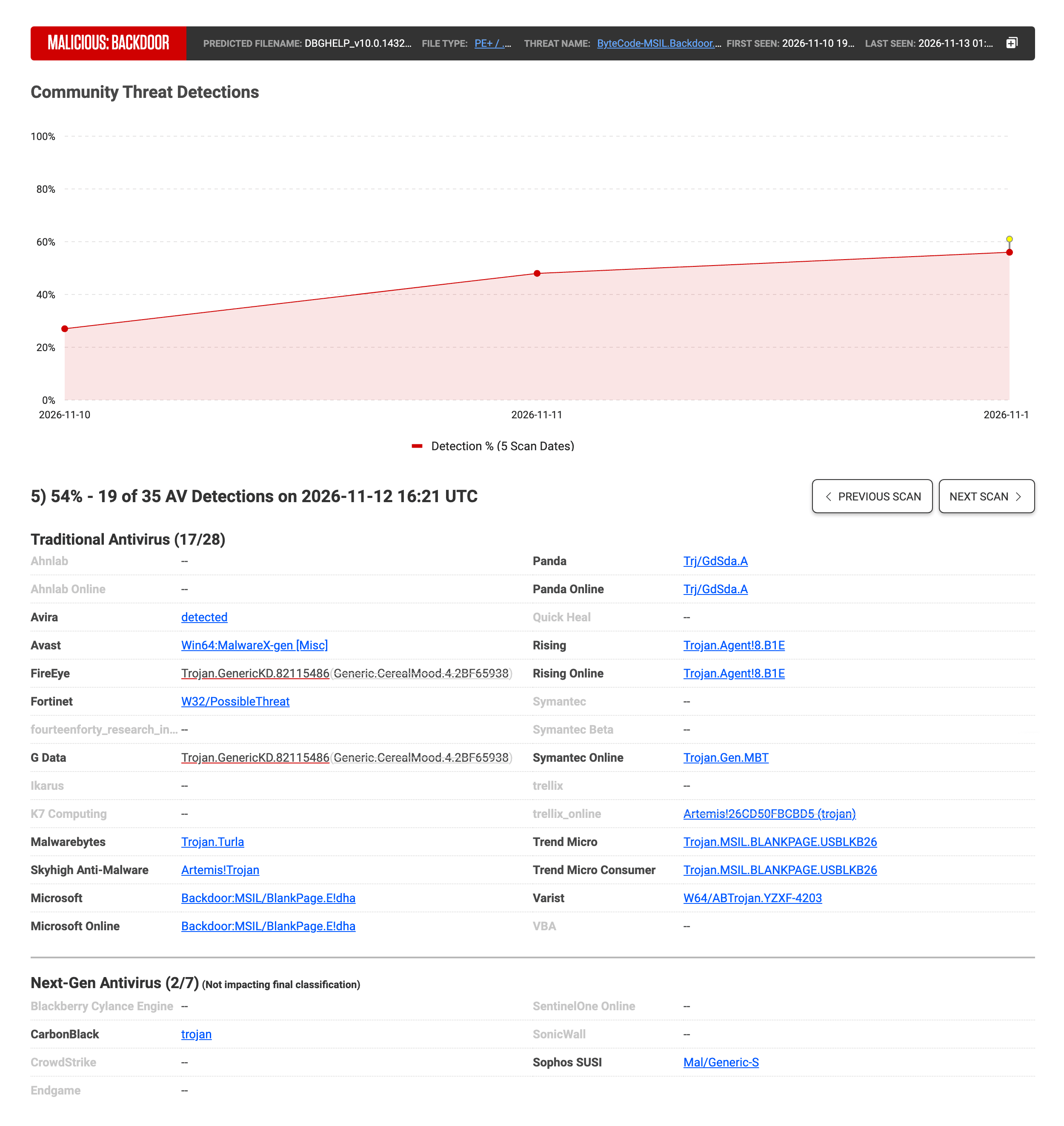
The first obstacle to counting CerealLoader accurately is naming. ESET uses CerealLoader for the loader component of the Cereal toolset. ESET’s own products detect these files under the generic names MSIL/Agent.YCA and MSIL/Agent.YCC. RL’s threat names for samples in the same cluster include BlankPage and CerealMood, and other engines apply further labels, among them BLANKPAGE and Trojan.Turla. In the RL reputation record, these descriptions can appear together on a single hash. Vendor detections show where those labels originate. On a later copy of the Microsoft.Search.Platform.dll build, Microsoft Defender reports Backdoor:MSIL/BlankPage.E!dha, Trend Micro reports Trojan.MSIL.BLANKPAGE.USBLKB26 and Malwarebytes reports Trojan.Turla, while two products built on the Bitdefender engine reported Generic.CerealMood before moving to a generic label. Across the cluster, Microsoft applies BlankPage variants .C, .E and .F, and RL’s family names follow that antivirus consensus. Counting only detections containing “CerealLoader” would therefore miss samples that other engines already associate with the family.
Figure 1. Community Threat Detections in Spectra Analyze for a later copy of the Microsoft.Search.Platform.dll build (SHA-1 beginning 539fe037): 19 of 35 engines on November 12, 2026, including Microsoft (Backdoor:MSIL/BlankPage.E!dha), Trend Micro (BLANKPAGE) and Malwarebytes (Trojan.Turla).
The history is equally informative. RL’s reputation record for one WTSAPI32.dll candidate carried a BlankPage family classification on March 4, 2026—more than eight months before ESET publicly described Cereal on November 10. That historical label is not evidence that RL attributed the campaign to Turla at the time; it shows that useful file-level detection signals can exist before a toolset receives its public name.
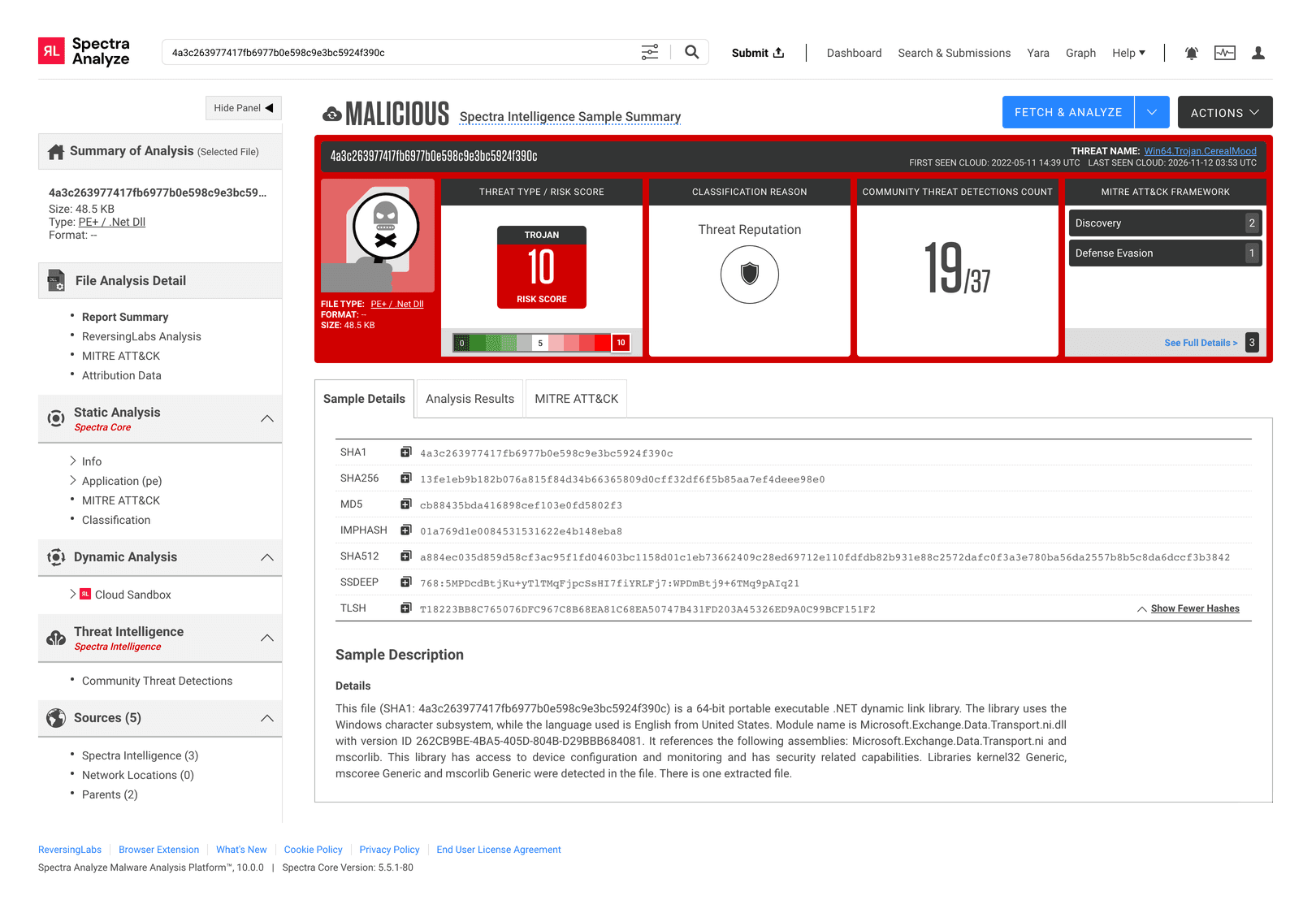
The earliest ESET-listed CerealLoader in our holdings first reached the RL corpus on May 11, 2022. ESET reports that the earliest CerealLoader it found was compiled on April 27, 2022 and uploaded to VirusTotal from Kazakhstan on May 11, 2022—the same day the file reached the RL corpus. The matching collection date makes it highly likely we are looking at that same artifact. A file’s first-seen date, however, should not be confused with the first known use in an intrusion. The government compromises ESET documented date to late 2025.
Figure 2A. Spectra Analyze record for the original Exchange loader held in the RL corpus since May 11, 2022. The analysis panel identifies the file as malicious.
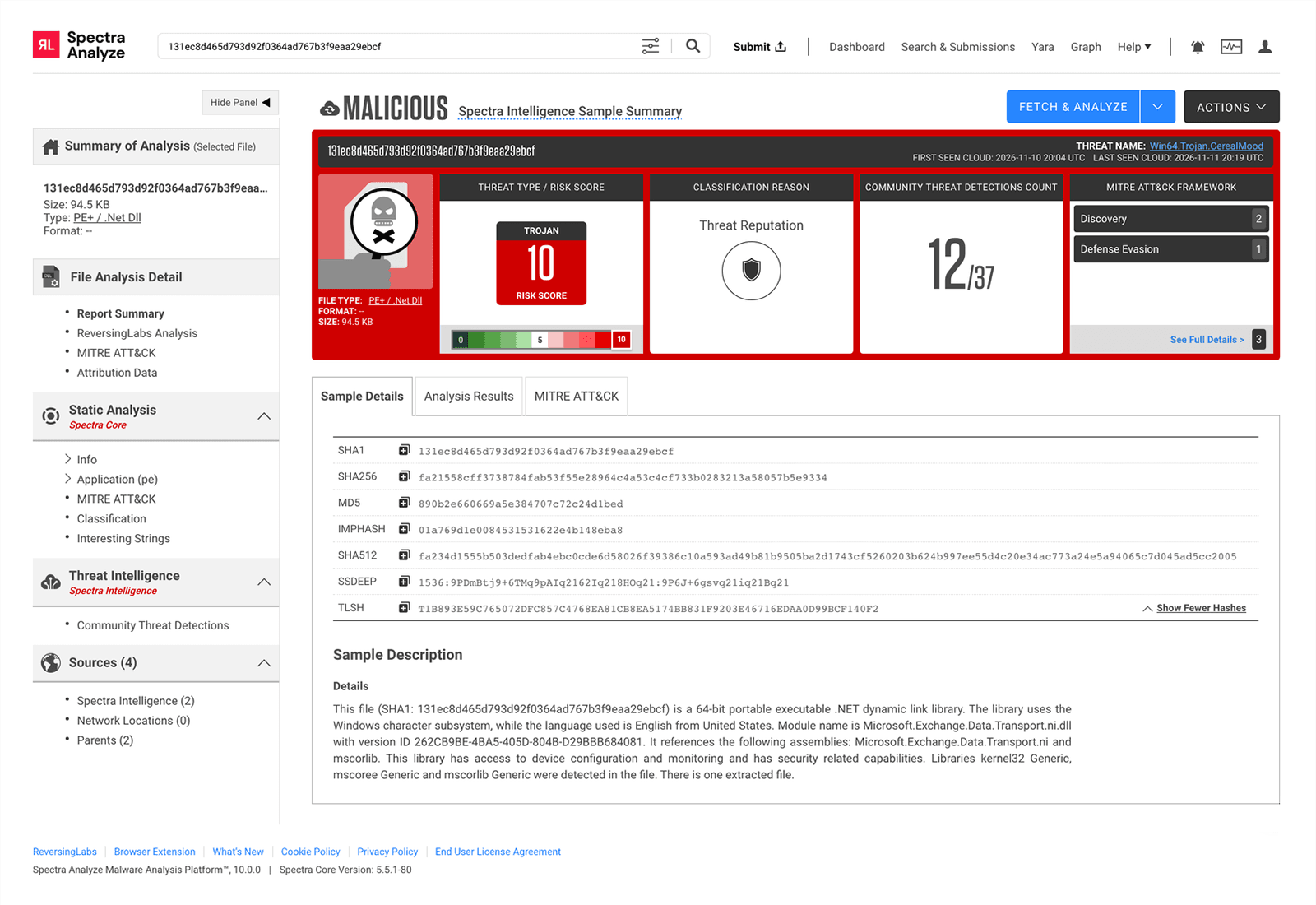
Figure 2B. A byte-different copy received in November 2026, shown in Spectra Analyze. Comparing the .NET metadata and timestamps connects it to the earlier build despite the changed file hash. The copy is larger (94.5 KB against 48.5 KB) because two .dnmd sections were appended; the original’s nine sections are unchanged and the RHA1 structural hash matches.
RL’s analysis of the two ESET-listed version.dll loaders surfaced a shared import hash, 6585e33ab016ca2c68ba7eec691fbeb5. A pivot on that value in RL’s analytics warehouse returned eight files. Five are classified malicious, including the ESET-listed files, a later copy and two previously unlisted samples named WTSAPI32.dll. Three additional files in the same import-hash group are classified goodware, so the import hash alone is a hunting lead rather than a definitive verdict.
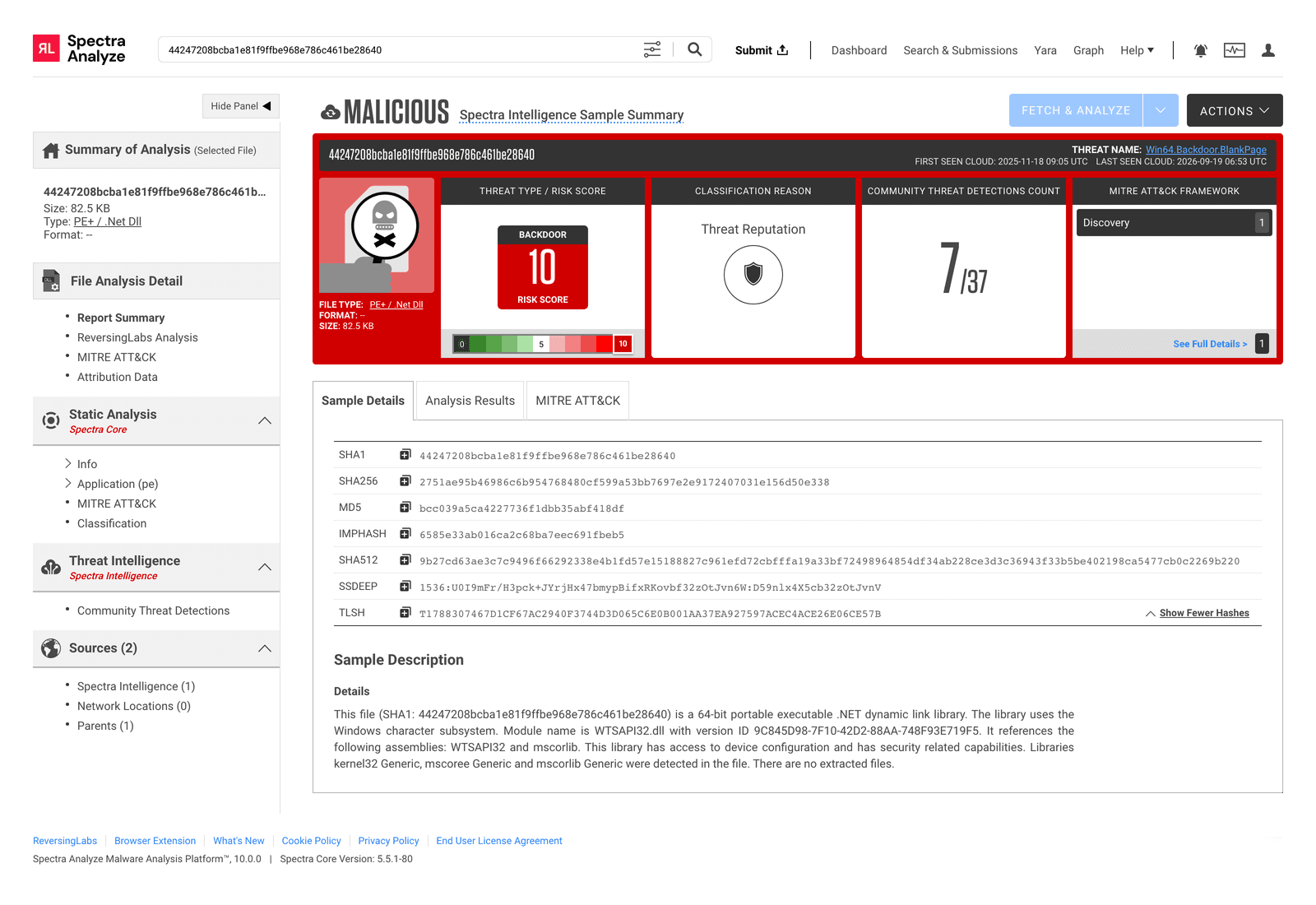
The later WTSAPI32.dll sample (SHA-256 beginning 35e4a9ec) has a high-confidence link to the CerealLoader family. Its import hash matches the version.dll cluster; it has a close TLSH similarity to a listed build; it is labeled BlankPage by Microsoft Defender (Backdoor:MSIL/BlankPage.C!dha); and it matches our native-entry-point hunting rule. A second WTSAPI32.dll sample (beginning 2751ae95) is a moderate-confidence match based on its import hash, filename, detection naming and spoofed Microsoft-style type names. That second sample reached the RL corpus on November 18, 2025, ten days before ESET’s first documented detection of Cereal. This is earlier file visibility, not evidence of an earlier confirmed victim.
We also recovered four byte-different copies of ESET-listed builds through retrospective YARA hunting and an ssdeep pivot. Each copy shares its known build’s .NET module version ID (MVID), compilation timestamp, import hash and RL structural hash (RHA1), but has a distinct cryptographic hash. The size difference has a structural explanation: the Figure 2B copy contains all nine sections of the original byte for byte, plus two appended .dnmd sections of 23,552 bytes each, and two other copies follow the same pattern. That points to post-processing by analysis tooling rather than separately deployed builds, so we treat the copies as detection hashes, not as evidence of additional victims. Those files matter operationally: a hash-only control built from the original public list would not automatically cover them.
Figure 3. Spectra Analyze record for the earlier WTSAPI32.dll loader (SHA-256 beginning 2751ae95), first seen by RL on November 18, 2025. Its import hash supports the relationship to the version.dll cluster.
ESET identified CerealLoader as the recognizable .NET component written to disk. It decrypts and runs other assemblies. CerealNeuron listens passively for encrypted requests sent to web paths that resemble Outlook Web Access, Autodiscover and ActiveSync. CerealBox then intercepts selected email from within the Exchange transport pipeline, using code injected into an existing process and wrapping handlers of already registered transport agents. Mail delivery continues and no new transport agent needs to appear in configuration.
These choices invert some common security assumptions. A backdoor that never phones home will not produce the routine outbound beacon defenders often hunt. A transport component that operates through existing in-memory handlers will not necessarily show up in a list of newly installed agents. And a loader that only activates through an expected Exchange or Windows process may be quiet when run by itself in a generic sandbox.
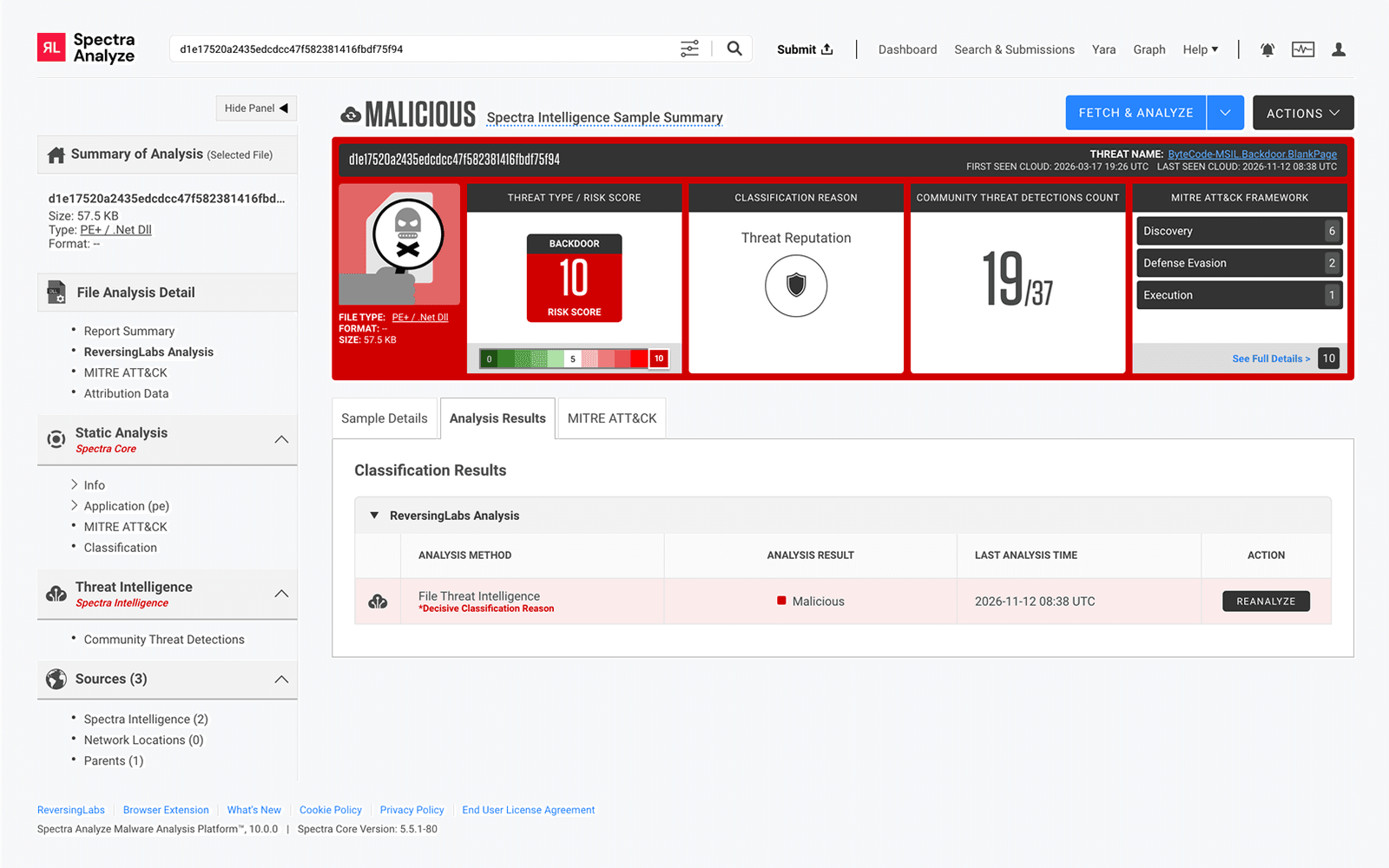
RL observed this last problem directly. Across our sandbox pipelines, the proxy DLL loaders preserved the export surfaces of the Windows libraries they impersonated. We saw behaviors associated with evasion, including extended sleeps, unusual process creation and direct or indirect system calls. But several loader samples received low sandbox risk scores, consistent with code awaiting its intended host context. On disk, static decomposition, metadata and multi-engine verdicts provided stronger evidence for those files than standalone detonation.
Figure 4A. Spectra Analyze classification view of the Microsoft.Ceres.dll loader (SHA-1 beginning d1e17520; SHA-256 beginning 41164eb0), first seen by RL on March 17, 2026 and classified malicious.
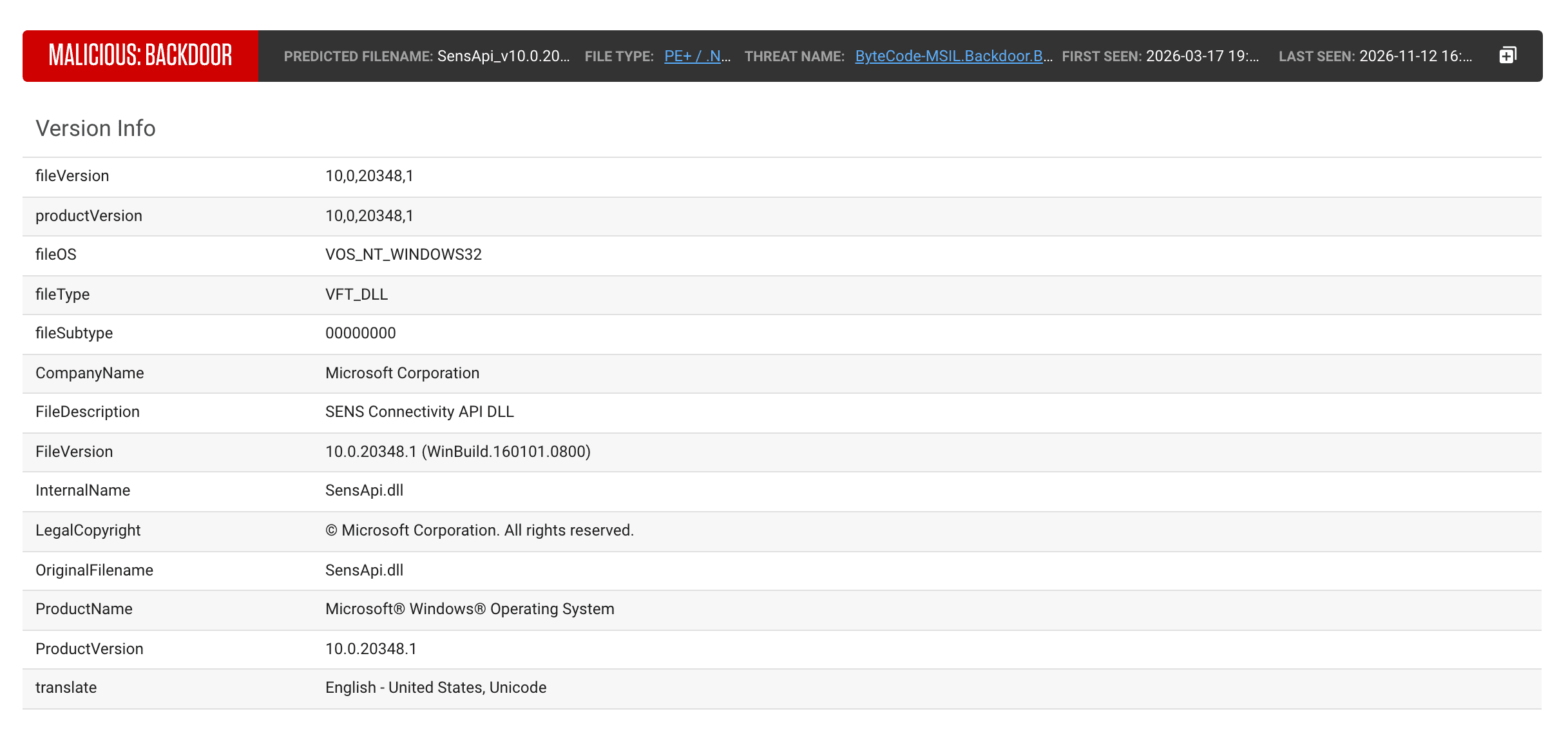
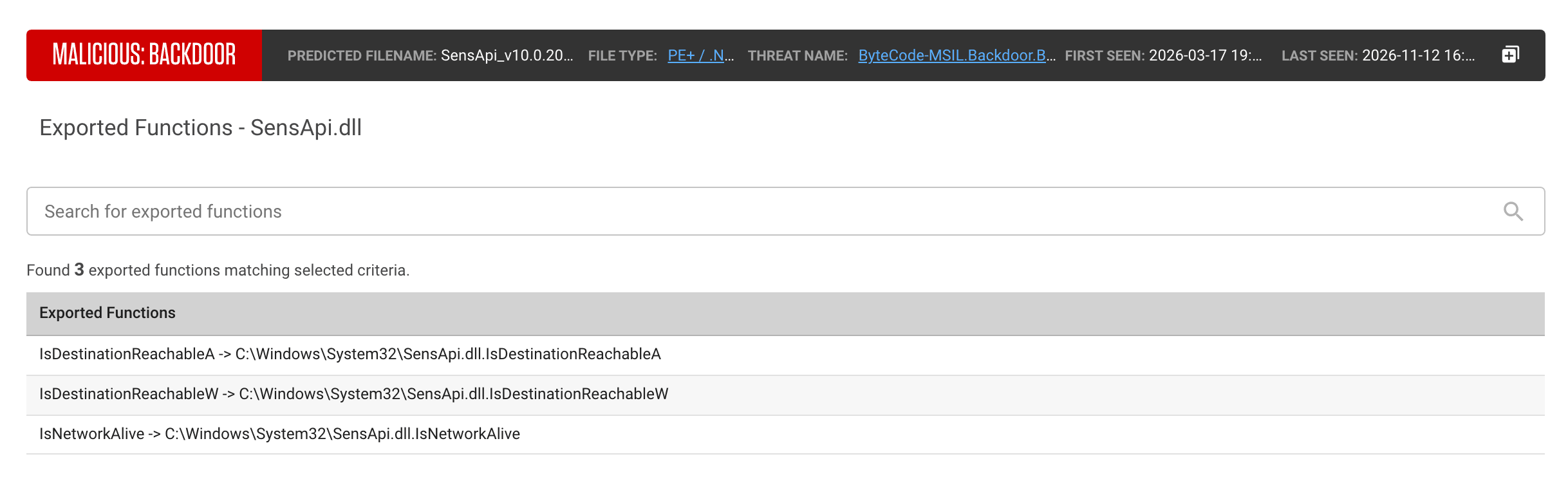
Figure 4B. Version Info for the same file: InternalName and OriginalFilename SensApi.dll, FileDescription “SENS Connectivity API DLL” and FileVersion 10.0.20348.1, presented as a Microsoft Windows component.
Figure 4C. The file’s export directory is named SensApi.dll, and all three exports forward to the genuine C:\Windows\System32\SensApi.dll, the construction of a side-loading proxy DLL.
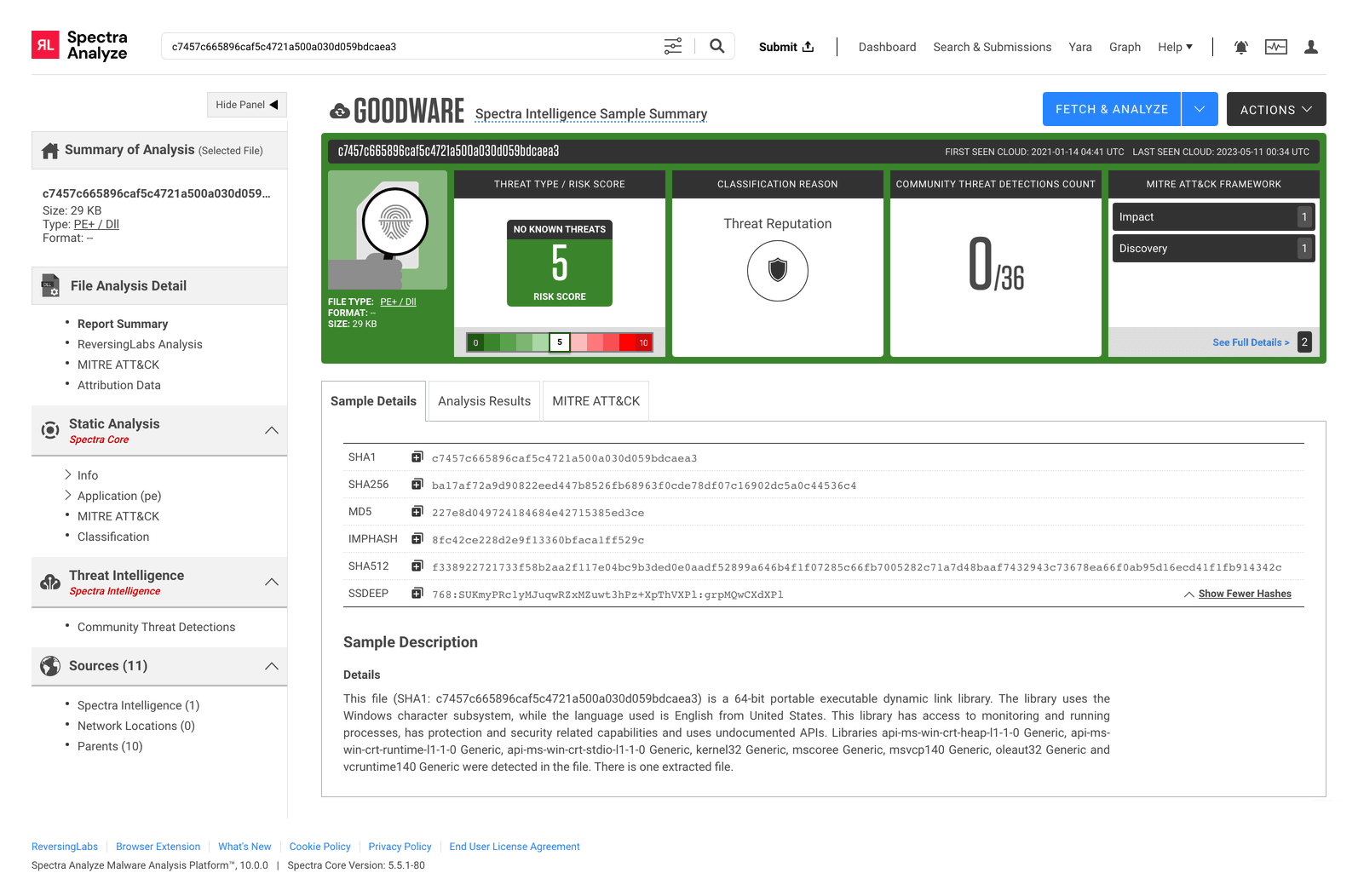
The complementary failure mode appeared in related, older Turla tooling. Two NetBootstrapper DLLs extracted from NetInjector containers had zero scanner detections when considered as standalone files (0 of 36 for the x64 build in Figure 5; 0 of 35 for the Win32 build), yet RL Cloud Sandbox assigned both a malicious verdict with a Turla signature. Decomposition linked these bootstrappers to their parent injectors. Neither observation means every clean static verdict is malicious or every quiet detonation is safe; the point is that file provenance, structure, relationships and behavior need to be assessed together.
Figure 5. The extracted NetBootstrapper_x64.dll appears as goodware in the standalone Spectra Analyze reputation view. Its relationship to a malicious NetInjector carrier is revealed through embedded-file analysis.
Cereal also fits a documented pattern of hiding attacker-controlled code inside servers that organizations already expose and trust. In 2017, the UK’s National Cyber Security Centre described the Neuron and Nautilus tools used by Turla. ESET later reported LightNeuron, which abused Exchange transport agents. CerealNeuron revisits the passive listener idea—ESET assesses it as a separate malware family that may have drawn inspiration from Neuron, not a new version of it—while CerealBox avoids the new agent registration that could reveal LightNeuron. The sophistication lies in how these ideas are recombined and made less visible to established checks.
To test that continuity in file data, RL reviewed 152 published hashes across 11 sets of Exchange- and IIS-resident malware and related Turla tooling. Our corpus contains 81 corresponding files. We also identified two additional copies of the 2019 NetInjector build that complement the indicators Unit 42 published in 2021. Spectra Core extracted the embedded bootstrapper DLLs from those containers, making the relationship visible even though each extracted child was classified as goodware on its own. The 81-file figure describes coverage of a curated published indicator set, not the number of active infections.
These findings matter most to organizations that run on-premises Exchange or hybrid environments with Exchange servers under their control. The recommended response is a targeted hunt that combines published indicators with host inspection—not an assumption that every Exchange environment has been compromised.
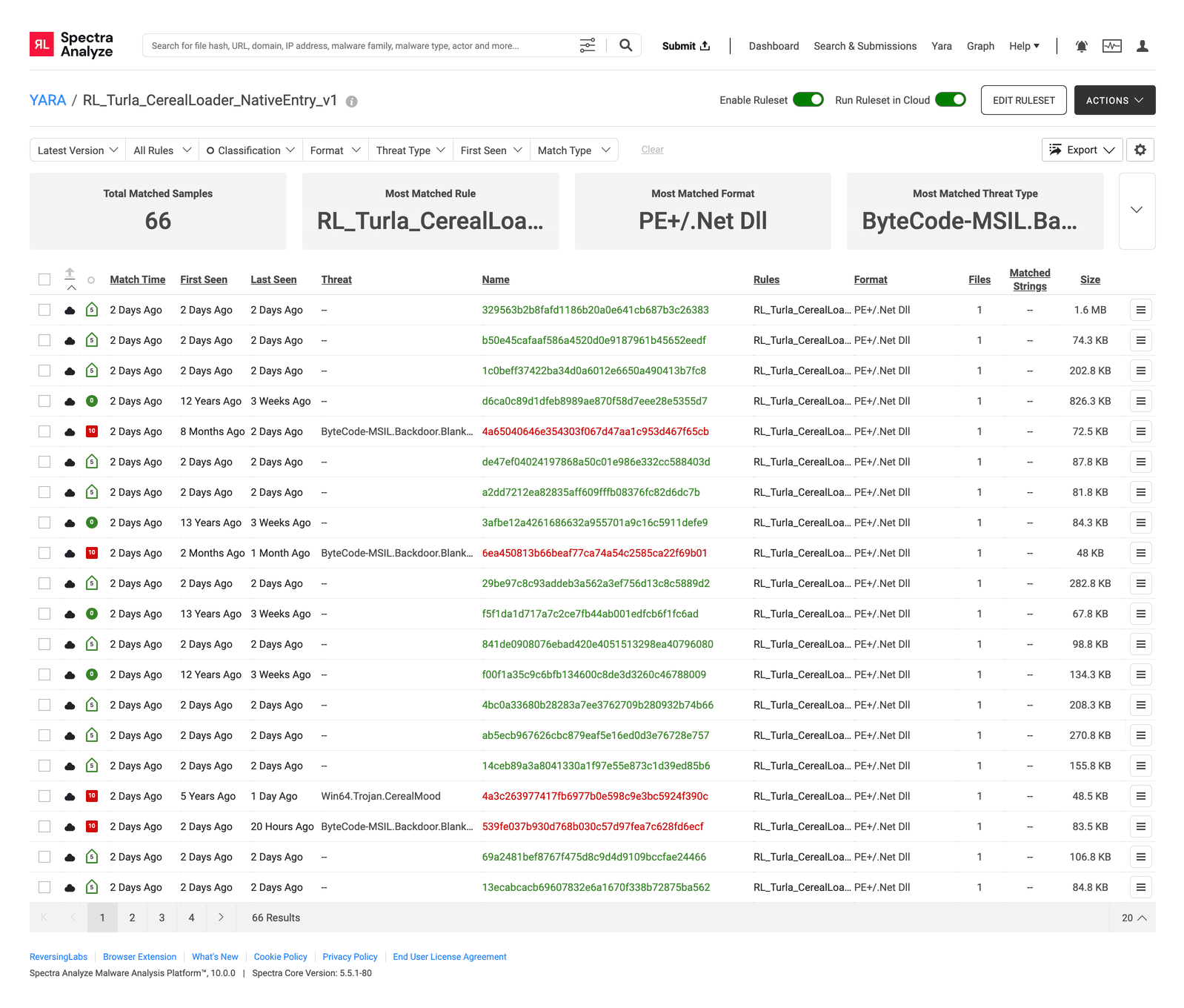
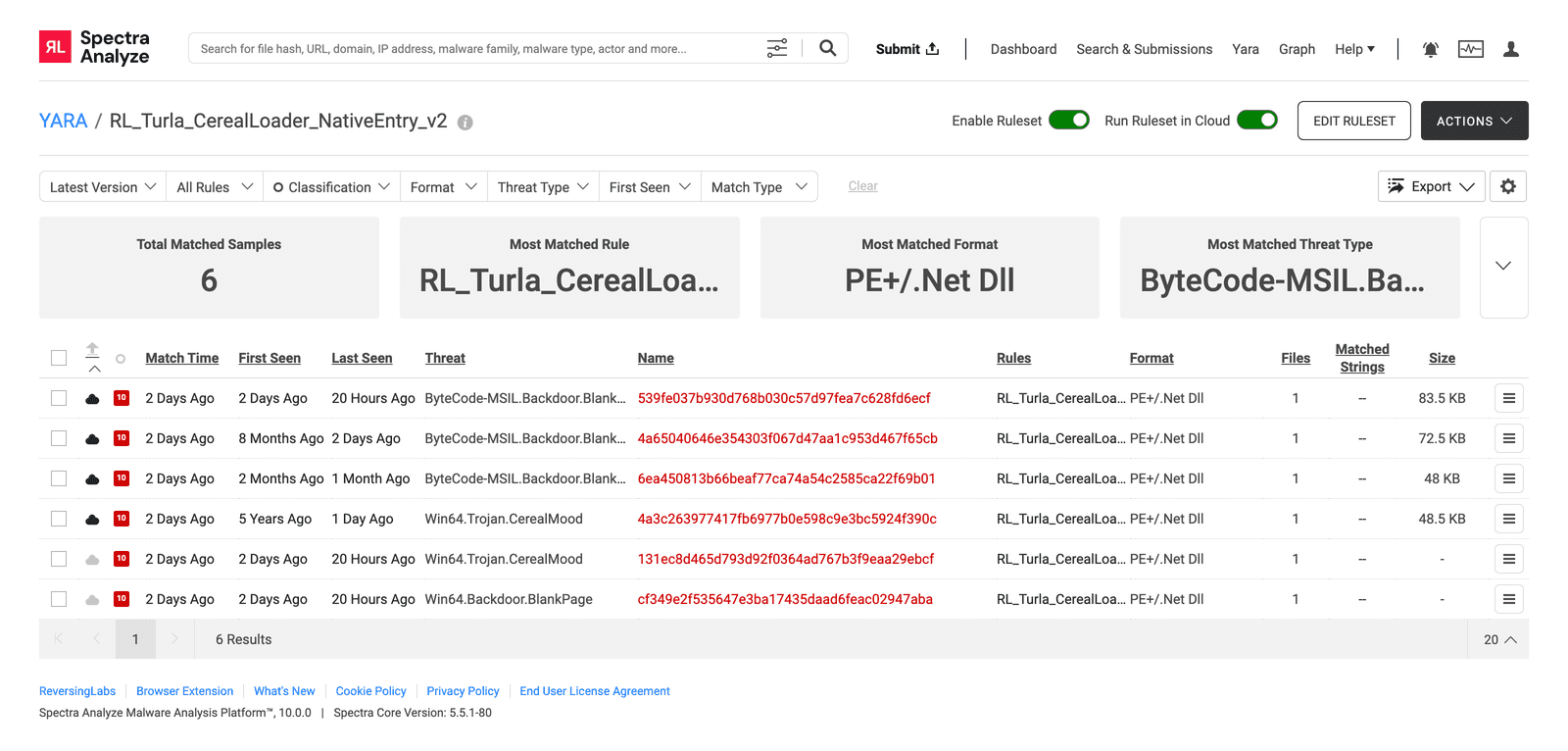
Two details make that final step important. In an early RL Retro test, a native-entry-point rule without a signature check returned six malicious loader-cluster samples and 60 legitimate Microsoft-signed Exchange assemblies before the run was stopped. Adding an unsigned-file condition narrowed the next partial test to six malicious samples. The rule published in the appendix is a later, third revision whose Retro run had not completed when this draft was prepared. In a local positive-control test on 14 related samples, the third revision matched all 10 CerealLoader files, including the EdgeSyncSvc build, and none of the four NetInjector and bootstrapper files. Separately, the import-hash rule deliberately remains a broad lead because goodware-classified files share that value. The eight-file count comes from the warehouse query; the import-hash rule’s own Retro run, visible in Figures 6, showed one malicious match at the time of capture. Detection precision comes from combining conditions and checking the host context—not from treating any one attribute as proof.
Figure 6A. The first version of the native-entry-point YARA hunt returned 66 matches, including legitimate Microsoft Exchange assemblies. This highlighted the need for a stronger discriminator.
Figure 6B. After adding the unsigned-file condition, the refined rule returned six matches in this partial Retro run, all classified as malicious. Hunt results still require host-specific baselining.
Researchers began with ESET’s 18 published SHA-1 indicators and queried Spectra Intelligence. Spectra Core exposed PE metadata, version resources, export tables and embedded resources. Spectra Analyze supplied similarity searches, YARA Retro and RL Cloud Sandbox; the team also compared Joe Sandbox and AssemblyLine results and queried import hashes and .NET metadata in RL’s analytics warehouse. Vendor classifications and scanner counts are point-in-time snapshots from November 10–13, 2026. The attribution of the Cereal campaign, victim details and the internal function of its components come from ESET’s research; RL’s independent contribution is file correlation, additional candidates and copies, comparative detonation, and hunting guidance.
Figure 7. Cereal-related hunting rules in the ReversingLabs Spectra Analyze YARA workspace. Retro counts at capture: version 1, six malicious and 60 goodware; version 2, six malicious; import-hash rule, one malicious; version 3 still running.
Cereal illustrates how little an adversary may need to change in order to stay out of view. A compromised mail server can host the attacker’s listener. A copied Windows filename can make a malicious DLL look routine. A renamed variant can escape a narrowly written detection, and a seemingly clean embedded library can acquire an entirely different meaning when traced back to its parent file.
For defenders, this is a reason to preserve and interrogate the files behind security events. Correlate aliases, inspect software structure, map a file to its host and parent process, and replay updated rules against historical samples. That is how a suspicious loader becomes a traceable family rather than an isolated hash.
Explore ReversingLabs Spectra Analyze and Spectra Intelligence to investigate Cereal-related files and run retrospective hunts. Download the complete indicators and use YARA rules from this blog.
Primary disclosure and attribution: ESET Research (Matías Porolli), “Exchange for breakfast: Turla’s Cereal tricks are not for kids,” November 10, 2026: https://www.welivesecurity.com/en/eset-research/exchange-for-breakfast-turlas-cereal-tricks-are-not-for-kids/
Detailed technical report: ESET, “Turla’s Cereal tricks” white paper: https://web-assets.esetstatic.com/wls/en/papers/white-papers/turla-cereal-tricks.pdf
Supplemental lineage: NCSC Neuron/Nautilus (2017); ESET LightNeuron (2019); Unit 42 IronNetInjector (2021).
Indicators and YARA conditions are research leads that require validation in each environment; attribution of a newly encountered file should not rest on a single match. ESET publishes SHA-1 values only. The SHA-256 values below are RL’s resolution of ESET’s SHA-1 indicators through Spectra Intelligence, re-verified on November 13, 2026.
Relationship | File or build | SHA-256 |
|---|---|---|
ESET-listed | Microsoft.Exchange.Data.Transport.ni.dll | 13fe1eb9b182b076a815f84d34b66365809d0cff32df6f5b85aa7ef4deee98e0 |
ESET-listed | Microsoft.Exchange.EdgeSyncSvc.ni.exe | 12e2060236a9b2a2933dfdb92b571949f7595fbe884642de83fea2817f17b94f |
ESET-listed | Microsoft.Ceres.dll | 41164eb06adc72b187edaf90d73ca73be729d4ebfdecf57d7398561136941651 |
ESET-listed | Microsoft.Search.Platform.dll | 6119d25ae51d04264384f5d738c104e42596b0774609666b357a43608a48404c |
File | SHA-256 |
|---|---|
NetInjector.dll | b6158a9b3ad825684072093d53a8b3982e3ef5390c097aae47e2a4157c88bba2 |
NetInjector_v1.0.0.0.dll | cfbe108f2ca32a8badaae8c863996f89f6588d837d87f78925ddbf986f298239 |
Shared import hash (not malicious by itself): 6585e33ab016ca2c68ba7eec691fbeb5
Reported CerealNeuron URL paths (HTTPS port 443; normalize case when inspecting logs):
Rule 1 intentionally matches a shared import hash. Rule 2 uses an unsigned .NET native-entry-point condition and names derived from published and RL-observed samples. Rule 2 is the third revision; the Retro results in Figures 6A and 6B come from the first and second. Rule 2 still covers the Microsoft.Exchange.EdgeSyncSvc.ni.exe loader: despite its .exe name, the file is marked as a DLL in its PE header, and the local test matched it. These are research rules and may need adaptation to the installed YARA/PE/.NET module version.
RULE 1 — IMPORT HASH
import "pe"

rule RL_Turla_CerealLoader_Imphash_v1
{
    meta:
        description = "Imphash hunting lead; also matches some goodware-classified files"
        author = "ReversingLabs"
        date = "2026-11-11"
        score = 70
    condition:
        uint16(0) == 0x5A4D and
        pe.is_dll() and
        pe.imphash() == "6585e33ab016ca2c68ba7eec691fbeb5"
}
RULE 2 — NATIVE ENTRY
import "pe"
import "dotnet"

rule RL_Turla_CerealLoader_NativeEntry_v3
{
    meta:
        description = "Unsigned .NET loader with native entry point and borrowed name"
        author = "ReversingLabs"
        date = "2026-11-11"
        score = 70
    condition:
        uint16(0) == 0x5A4D and
        pe.is_dll() and
        dotnet.is_dotnet == 1 and
        pe.number_of_signatures == 0 and
        pe.data_directories[pe.IMAGE_DIRECTORY_ENTRY_COM_DESCRIPTOR].virtual_address != 0 and
        (uint32(pe.rva_to_offset(pe.data_directories[pe.IMAGE_DIRECTORY_ENTRY_COM_DESCRIPTOR].virtual_address) + 16) & 0x10) == 0x10 and
        dotnet.module_name matches /^(version|wtsapi32|ncobjapi|wbemcomn|dbghelp|sensapi|Microsoft\.(Ceres|Search\.Platform|Exchange\.[A-Za-z.]+))\.(ni\.)?(dll|exe)$/i
}
ESET-listed |
version.dll |
d3b6065eb001d169421fcd146f64b087055dadebd973d8d69ae2bf97fbf288e2 |
ESET-listed | version.dll | 241aac14756a0f29edd084b858623db259d59c77ea44889de93431c42ff10036 |
Additional candidate — high confidence | WTSAPI32.dll | 35e4a9ecc12d8c4276dbdfd8e476acbe118bd5915c19fbde0345d2ac75e5cf1b |
Additional candidate — moderate confidence | WTSAPI32.dll | 2751ae95b46986c6b954768480cf599a53bb7697e2e9172407031e156d50e338 |
Same-build copy | Microsoft.Ceres.dll build | 2b9ce8e85327a1507806ce597c0d81ebb7c579af58b0dac9021de3deeb2f93c1 |
Same-build copy | Microsoft.Search.Platform.dll build | 5f80fbc869b9c7ce1d17682f70224db74476aebcd194a1450e2dfef36dd0ff93 |
Same-build copy | Microsoft.Exchange.Data.Transport.ni.dll build | fa21558cff3738784fab53f55e28964c4a53c4cf733b0283213a58057b5e9334 |
Same-build copy | version.dll build | 38f28aa6381d972e2e82faabf90c05d0434468ed7bd6a252775377e528edbdca |

CISA's Java4Shell alert starts with a step most teams can't finish quickly: finding every Java runtime, including the ones vendors bundled for you.
How a vulnerability in Optimizely exposed visitors of at least 178 organizations’ websites to malicious code, revealing a critical blind spot in third-party software trust.